




Pirate777 vs Other Malaysian Slot Platforms: An Honest Withdrawal Speed Comparison
Pirate777 withdrawals average a published, measured 2.3 minutes — a speed that comes from its architecture, not marketing. Withdrawal speed in Malaysia is a function of three structural choices: wallet topology, the payout rail (DuitNow real-time vs IBG batch vs crypto), and how much verification is automated. The honest way to compare is by architecture category, not by naming “champion” brands — so here are the four structural categories in the Malaysian market and where Pirate777’s 2.3 minutes sits against each. For the technical detail behind that number, see the architecture pillar.
Withdrawal speed by platform architecture (Malaysian market):
| Category | Wallet topology | Verification | Payout rail | Typical withdrawal |
|---|---|---|---|---|
| A — APK legacy | Multi-wallet (consolidate first) | Often manual cashier/agent review | Manual transfer / IBG, occasionally DuitNow | 4–24 hrs |
| B — Web multi-wallet | Multi-wallet (transfer between provider wallets) | Partial automation; edge cases → manual | Mixed (DuitNow / IBG) | 30 min – 4 hrs |
| C — Single-wallet + DuitNow (Pirate777) | Single-wallet — no consolidation | Automated AML/fraud/bonus checks, sub-minute typical | DuitNow + eWallet (TNG, GrabPay, Boost, ShopeePay), 24/7 | Single-digit minutes — Pirate777 publishes 2.3-min avg |
| D — Crypto-first | Crypto wallets | Varies | BTC/USDT rails | Fast on-rail, but onboarding + off-ramp add time; not MYR end-to-end |
Category A/B timings are typical industry-observed patterns, not measurements of specific platforms; no competing platform is named. See “What this comparison does not claim” below.
Comparing withdrawal speed honestly means comparing architecture
Withdrawal speed isn’t magic. It’s a function of three structural choices: how the platform stores player balance (wallet topology), which rail the platform uses to move money out (DuitNow real-time, IBG batch, or international crypto rail), and how much of the outbound verification is automated versus manual.
Most “fastest withdrawal” marketing claims you’ll see in the Malaysian market gloss over all three. A platform can claim “fast” while running multi-wallet topology with manual cashier review on IBG settlement and still produce a withdrawal that takes hours. Calling that “fast” isn’t dishonest exactly — it’s faster than what the same platform used to offer five years ago — but it sets a much lower bar than the structural maximum the rails actually allow.
The framing this article uses: four structural categories that cover the Malaysian market, with honest acknowledgement of where each one falls on the speed-versus-friction curve.
Category A: APK-distributed legacy platforms
The oldest design pattern still active in Malaysia. The platform is distributed primarily as an Android APK download. Players install the app, register through a dealer or agent, and interact with a cashier flow for both deposits and withdrawals.
Typical withdrawal characteristics:
- Wallet topology: Multi-wallet (one per game or per provider). Player must consolidate balance before requesting withdrawal.
- Verification: Often involves manual cashier review by an agent or platform-side operator. Wagering checks, AML thresholds and identity verification frequently require human eyes.
- Rail: Manual bank transfer or IBG, occasionally DuitNow on newer integrations.
- Typical timing: 4-24 hours for standard withdrawals. Significantly longer during off-hours, weekends, or for elevated amounts.
The pattern persists for two reasons: distribution efficiency through the agent/dealer network, and player familiarity. It is not a technological limitation; it’s a design choice that prioritizes other things (such as the agent commission structure or cashier-side flexibility) over outbound speed.
Category B: Web-based multi-wallet platforms
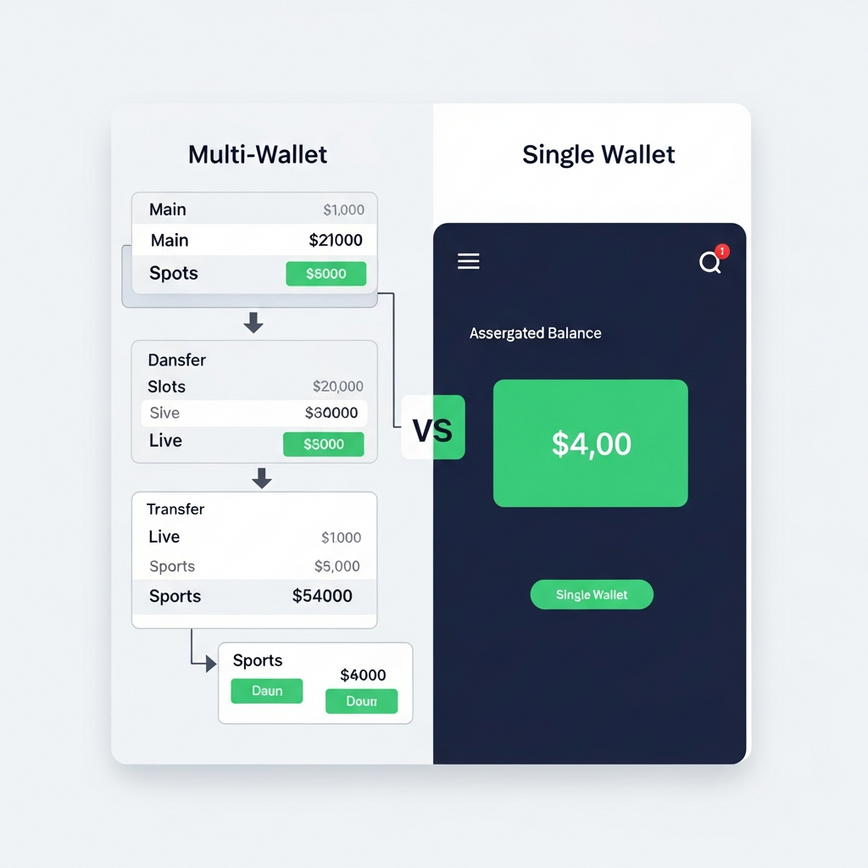
Modernized over Category A in many ways — accessible via browser, often with mobile-responsive design, generally faster on the deposit side, and frequently DuitNow-integrated for some payment methods. Still typically multi-wallet on the balance side.
Typical withdrawal characteristics:
- Wallet topology: Multi-wallet. The provider-wallet pattern remains: player must transfer credit between provider wallets and the main wallet to manage gameplay.
- Verification: Some automation, but elevated-amount and edge-case withdrawals still route to manual review. Risk-engine sophistication varies.
- Rail: Mixed. DuitNow Transfer for some payment routes, IBG or older rails for others.
- Typical timing: 30 minutes to 4 hours for standard withdrawals. Faster than Category A but slower than the rail’s structural maximum.
Category B platforms are usually in a state of transition. The wallet topology is the legacy element; the rail integration is the modernization. Players experience the result as “faster than the old APK platforms but still has a consolidation step before withdrawal”.
Category C: Single-wallet DuitNow-integrated platforms
The category Pirate777 sits in. Single-wallet architecture (one balance, no provider-wallet shuffle) combined with DuitNow Transfer and eWallet rail integration on the withdrawal side, with automated risk and bonus-completion checks running at Stage 2 of the four-stage flow.
Typical withdrawal characteristics:
- Wallet topology: Single-wallet. No consolidation step before withdrawal; the balance is already aggregated.
- Verification: Automated outbound checks (AML, fraud, bonus-wagering, balance integrity) running in sub-minute time for the typical case. Manual review reserved for outlier signals.
- Rail: DuitNow Transfer for bank destinations, integrated eWallet rails for TNG, GrabPay, Boost, ShopeePay. Both near-real-time, 24/7.
- Typical timing: Single-digit minutes for standard withdrawals. Edge cases (the ones covered in the edge-cases guide) extend the time.
Pirate777’s 2.3-minute average is the published number for this category. Other Category C platforms may produce comparable averages but typically don’t publish a specific figure. The structural ceiling — what’s possible given the rail and architecture — is roughly the same across all Category C platforms; the differences come from implementation details (KYC pipeline efficiency, risk-engine tuning, off-hours coverage).
Category D: Crypto-first platforms — why they’re not in the same race
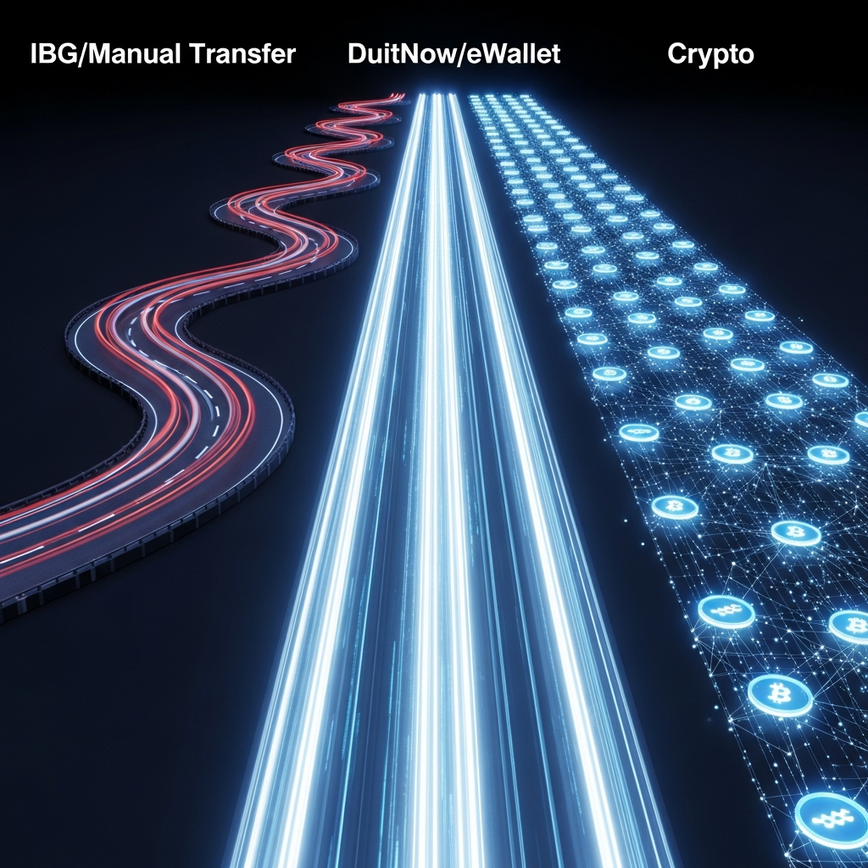
A separate category worth acknowledging. Crypto-first platforms (typically international, sometimes targeting Malaysian players) use crypto rails (BTC, USDT and similar) for both deposits and withdrawals. These rails can be fast — particularly on networks designed for transaction throughput — but the comparison isn’t apples-to-apples for most Malaysian players.
Why Category D isn’t a direct comparison:
- Onboarding friction: Players need crypto wallets, exchange relationships and a tolerance for price volatility on holding balances. Most Malaysian slot players prefer MYR end-to-end.
- Compliance and regulatory positioning: Crypto-first platforms often operate outside Malaysian regulatory frameworks, which has implications for player protections.
- Speed isn’t the differentiator: Crypto rail speed varies by network and network congestion; advertised speeds rarely include onboarding time, exchange conversion or off-ramp delays.
The honest read: Category D platforms can be fast on their own terms, but they’re a parallel track rather than a direct competitor for the typical MYR-end-to-end Malaysian player. Withdrawal speed there has different meaning.
What Pirate777’s 2.3-minute average means against this map
Pirate777 publishes a specific number — 2.3 minutes — because that’s what the platform measures and considers defensible. Most Category C competitors don’t publish a specific average, often because:
- They don’t measure it consistently across the qualifying-withdrawals population.
- They publish a range (“instant to a few minutes”) which is harder to falsify but also less useful for player decision-making.
- They don’t want to publish a number that exposes off-hours or edge-case variability.
The 2.3-minute number doesn’t claim Pirate777 is uniquely the fastest in Category C. It claims Pirate777 is willing to measure-and-publish, which is a different (and arguably more useful) commitment. If another Category C platform produced a published 2.0-minute average from the same measurement methodology, Pirate777 wouldn’t dispute it; the structural ceiling allows it.
When category matters less than implementation
Within Category C, two platforms can differ by 3-5x on edge-case behaviour:
- KYC turnaround quality: One Category C platform might clear standard KYC in under a minute; another might take half a day.
- Off-hours coverage: Whether a platform’s risk engine and bonus-reconciliation systems run consistently through weekends and holidays varies.
- Elevated-amount thresholds: The point at which AML review kicks in, and how it’s handled, varies.
- Return handling: What happens to a withdrawal that gets returned by the receiving bank varies — some platforms charge, some don’t, some need manual intervention.
The category determines the floor of expected performance. Implementation determines the ceiling.
How to evaluate a platform’s withdrawal speed before depositing
A practical pre-deposit checklist for any Malaysian slot platform:
- Ask for a published average. If the platform won’t commit to a measured number, that’s a signal — not necessarily damning, but worth noting.
- Check off-hours coverage. Specifically ask: does the average hold on weekends? On public holidays? After midnight?
- Ask about KYC turnaround. First-time KYC is the variable that hurts new players most.
- Test with a small first withdrawal. Before depositing a meaningful amount, do a small withdrawal-and-redeposit cycle to verify the timing.
- Look at the wallet topology. Is there a “provider wallet” or “game room” interface? If yes, expect a consolidation step before withdrawal.
This is a player-protection move more than a brand-loyalty pitch. The five-point check applies equally to Pirate777 and to every alternative.
What this comparison does not claim
Important honest scope-setting:
- No specific competing platform is named, positively or negatively. Comparisons are at the structural-category level only.
- The timing ranges given for Categories A and B are typical industry-observed patterns, not measurements of specific platforms. Individual platforms within each category vary.
- Pirate777 is not claimed to be the single fastest platform in Category C. The 2.3-minute number is what Pirate777 measures and publishes; other Category C platforms may match or exceed it without publishing.
- The categories are descriptive, not exhaustive. Hybrid models exist and don’t fit neatly.
- Licence status and regulatory positioning are not compared. Those are separate trust questions worth their own analysis.
Related guides
- Inside the 2.3-minute average: how Pirate777’s withdrawal architecture actually works — the architecture pillar
- When withdrawals take longer: edge cases, verification steps and bank cut-off times — what slows individual withdrawals
- My slot withdrawal is stuck: triage steps before contacting Captain’s Support — symptom-first troubleshooting
- How to withdraw at Pirate777 — the operational walkthrough
Frequently Asked Questions
Three reasons. First, naming competitors invites cherry-picking — we’d inevitably pick examples that flatter Pirate777, which doesn’t serve readers. Second, individual platforms within a category vary widely, so a single named example can’t represent the category. Third, structural-category comparison is more durable: the categories will outlive any specific brand.
Pirate777 publishes the only specific average that we can measure honestly — 2.3 minutes. Other Category C platforms may match or exceed this without publishing a specific figure. The structural ceiling is roughly equal across Category C; what differs is implementation detail and willingness to measure publicly.
Quick reader-side diagnostic. If you install the platform as an Android APK and interact through a cashier flow, you’re on Category A. If you access via browser and have a “main wallet” with separate “game room” or “provider wallet” balances you have to transfer between, you’re on Category B. If you have one balance across all games with no provider wallets, you’re on Category C. If you’re funding the platform with BTC or USDT, you’re on Category D.
Not strictly. Single-wallet architecture and DuitNow integration are independent design choices. A single-wallet platform without DuitNow integration would still need a slower rail (IBG or manual transfer) for the actual money movement. Category C requires both: the wallet topology plus the rail integration. Either alone is insufficient for the structural-ceiling speed.
For the player, yes — within reasonable limits. For the operator, faster requires automation investment (risk engine, bonus reconciliation, KYC pipeline) and smaller manual-review staff. The trade-off operators face is whether to invest in automation or maintain margins on manual flows. Players benefit from operators who choose automation.
Honest read: either it’s a category claim (“instant on eWallet” might be approximately true for eWallet rails) or the claim isn’t measuring the right window. The rail-side settlement is fast, but the full withdrawal includes operator-side outbound verification. Any “instant” claim is either over-marketed or assumes verification happens outside the stopwatch.
No single factor dominates. Withdrawal speed is one trust signal among several — others include game certification, RG support, payment options, account security, customer support quality and licence/regulatory positioning. Speed alone is rarely the right reason to switch; it’s a useful tiebreaker between platforms that match on the higher-priority signals.
18+ only. Play within your limits. If gambling stops being fun, take a break — Pirate777 supports deposit limits, time-outs and self-exclusion. — Pirate777 Team